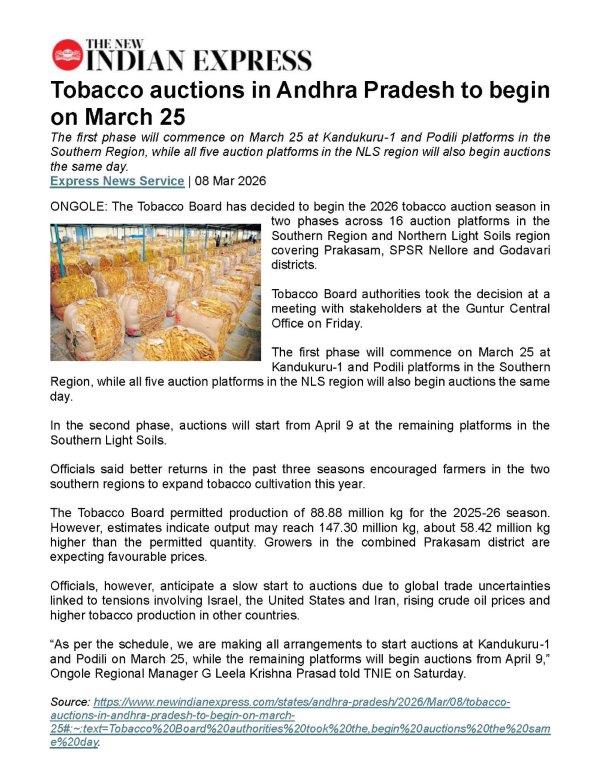
Tobacco provides direct and indirect employment to more than 45.7 million people, around 70% of whom are in the agricultural sector. Tobacco is a highly remunerative crop providing economic/social benefits to farmers in the tobacco growing regions.
ASSOCHAM study Tobacco Economics in India: The Voice of the Farmer and other Stakeholders found that the tobacco growing areas of the three major tobacco producing States in India, viz., Andhra Pradesh, Karnataka and Gujarat are better off in several socio-economic parameters as compared to the non-tobacco growing areas of these States. “…tobacco does create higher returns and other social capabilities for its farmers than those who are engaged in growing other cash crops,” the study report observed.
Studies conducted by the National Institute for Research on Commercial Agriculture (NIRCA; previously known as Central Tobacco Research Institute), Rajahmundry, have shown that FCV tobacco is more remunerative than other crops grown in the region, and is difficult to substitute.
The performance of FCV tobacco has been impressive, particularly in terms of farmer earnings. Between 2001-02 and 2013-14, the gross earnings of FCV tobacco growers have increased more than six times.
| FCV Tobacco | 2001-02 | 2013-14 | Change |
|---|---|---|---|
| Production (Mln. Kg) | 167.97 | 315.92 | 88% |
| Average Price (Rs/Kg) | 34.80 | 122.60 | 252% |
| Gross Returns (Rs Cr)* | 584.55 | 3873.19 | 563% |
| Exports (Rs Cr) | 483 | 4086 | 746% |
Source: Tobacco Board (*Derived)
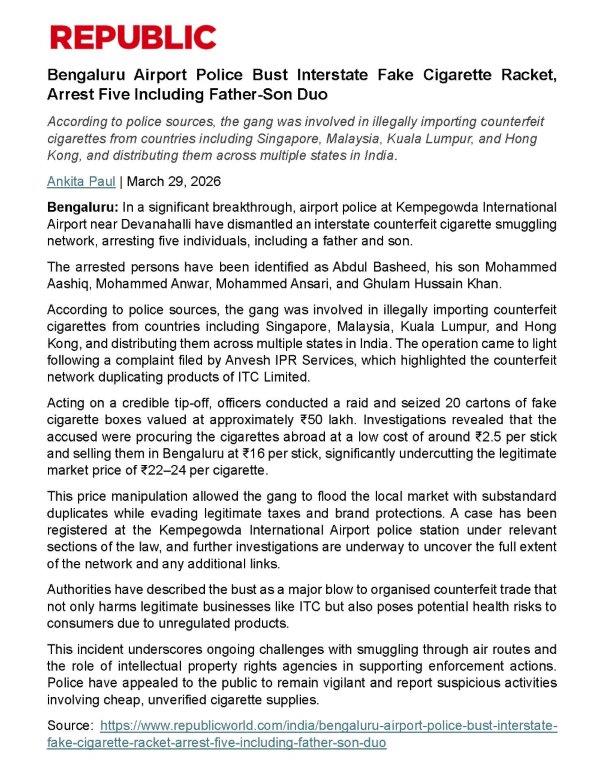
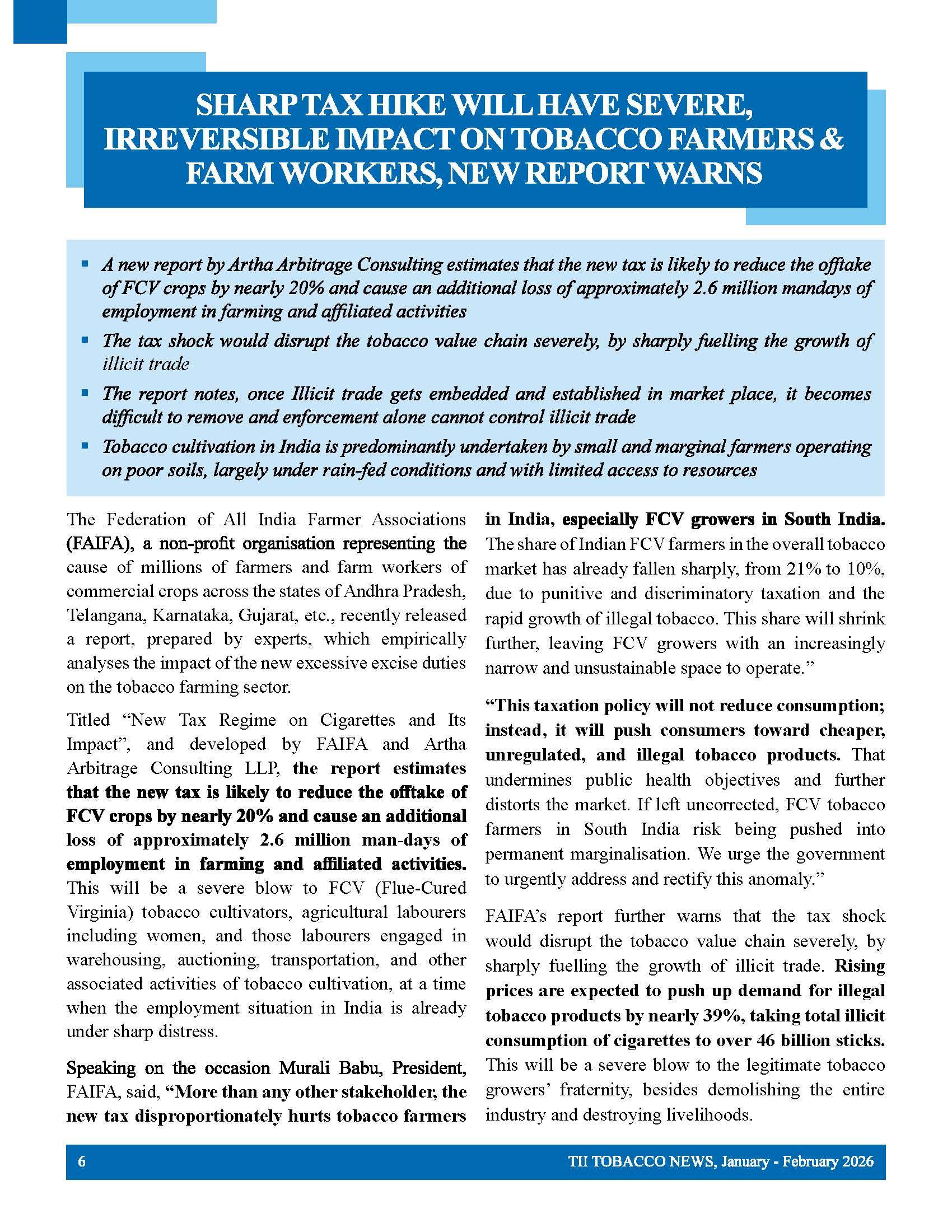
The growing illicit cigarette trade has had a severe impact on the Indian FCV tobacco farmers, as contraband products do not use locally grown tobacco. FCV tobacco production had dropped by a steep 40% between 2013-14 and 2021-22, resulting in shrinkage in earnings and loss of employment in tobacco-growing areas. The drop in crop production during the past decade (2013 to 2023) resulted in a cumulative loss of 238 million man-days of employment in tobacco growing areas.
The pragmatic tax policy of recent years has resulted in the recovery of legal volume and higher demand for domestic FCV tobaccos. Consequently, FCV crop production since 2022-23 has increased in the country.