The tobacco consumption pattern in India is unique in that only 10% of total tobacco is consumed in the form of Legal Cigarettes. The remaining 90% consumption is in the form of illegal cigarettes and 29 other tax-inefficient tobacco products such as bidis, chewing tobacco, khaini etc. This is unlike the rest of the world where cigarettes remain the dominant form of tobacco use accounting for 90% of total consumption.
Cigarettes bear the brunt of Tobacco Taxation in India
Despite a mere 10% share of consumption, Government collects a very high proportion of its total tobacco revenue from legal cigarettes. The reason for this distorted pattern of revenue collections is that cigarettes are subjected to high and inequitable taxation, as compared to other tobacco products, which are largely produced in the unorganised sector and are prone to tax evasion.
Consequently the legal cigarette share of total tobacco consumption in India has declined from 21% in 1981-82 to 10% in 2023-24. Overall tobacco consumption in the country has increased by 49% during this period.
Tobacco Consumption in India (Million Kgs)
|
Year |
Legal Cigarettes |
Other Tobacco forms* |
Total* |
|||
|
Million Kg. |
Share | Million Kg. | Share | Million Kg. |
Share |
|
|
1981-82 |
86 |
21% | 320 | 79% | 406 | 100% |
| 2023-24 |
62 |
10% |
543 | 90% | 605 | 100% |
| Difference | -24 (-28%) |
+233 (+70%) |
+199 |
|||
Source: USDA; Tobacco Board, Govt. of India; FAO; Industry estimates
*Other tobacco products Include illegal cigarettes
While the legal cigarette industry in India is in the organized sector, has statutory oversight and is completely compliant with all regulations the bulk of tobacco consumed is largely produced in the unorganized sector which does not have compliance or enforcement. This large unorganized sector (estimated at 68% of overall tobacco consumption) pays little tax either due to tax exemptions or evasion. Consequently, while on the one hand revenue collections are being sub-optimized, more importantly, overall tobacco consumption is also increasing.
Cigarette taxes in India are the highest in the world
As a percentage of per capita GDP, Cigarette taxes in India, of the most sold brand, are amongst the highest in the world as per the data released by WHO recently.

Source: Tax data – WHO Global Health Observatory, 2024 (Cigarette Tax data for 2022);
Per Capita GDP – (World Bank)(Data for the year 2022)
With such high levels of taxation, the affordability of legal cigarettes in India is significantly lower than many economies such as Japan, USA, Germany, China, UK, Pakistan and Malaysia.
 Source: WHO Global Health Observatory, 2024 (Data for 2022)
The unaffordability of legal cigarettes has led to a shift in consumption from legal tax-paid cigarettes to cheaper forms of tobacco consumption including tax-evaded illicit/smuggled cigarettes.
GST Regime Increased Tax Burden on Cigarettes
The Goods and Services Tax (GST) regime, introduced in July 2017, increased the tax burden on Cigarettes by increasing the GST Compensation Cess rates. The impact of the increase was a weighted average of 13% across the various length-based cigarette segments going up to 19% in the case of the >75mm length filter cigarettes (King-size) segment – a segment where numerous smuggled international brands are offered to consumers at prices below even the taxes applicable on such cigarettes.
Thereafter, in the Union Budget of February 2020, the NCCD rates were subjected to an overall weighted average tax increase of 13% and in the Union Budget of February 2023, NCCD rates on Cigarettes were increased by 16%.
During the period of high tax increases, Legal Cigarette Industry volumes saw a severe decline. Overall tobacco consumption, however, continued to grow due to shift in consumption from duty paid cigarettes to illicit cigarettes and other tax-inefficient forms of tobacco.
Sharp Unprecedent Increase in Taxes on Cigarettes
Excise duty rates leviable on Cigarettes with effect from 1st February, 2026, were notified vide the Notification GSR 955(E) No.03/2025 Central Excise dated 31st December, 2025. The excise duties have been imposed in lieu of the GST Compensation Cess levied on Cigarettes and other tobacco products. The high excise duty rates on cigarettes have resulted in unprecedented increase in taxes, despite the Government’s announcements that the overall impact of the transition of taxes will be revenue neutral.
The Excise duty rates are excessively high and as per the Jefferies Report – The Big Tax Shock, 1st January 2026, due to the GST @40% on Retail Sales Price (RSP), the effective tax hike comes to around 70%. It is important to highlight that GST will be charged on a higher base i.e. RSP, at an increased rate of 40% and the excise duty levy has a cascading (tax on tax) impact.
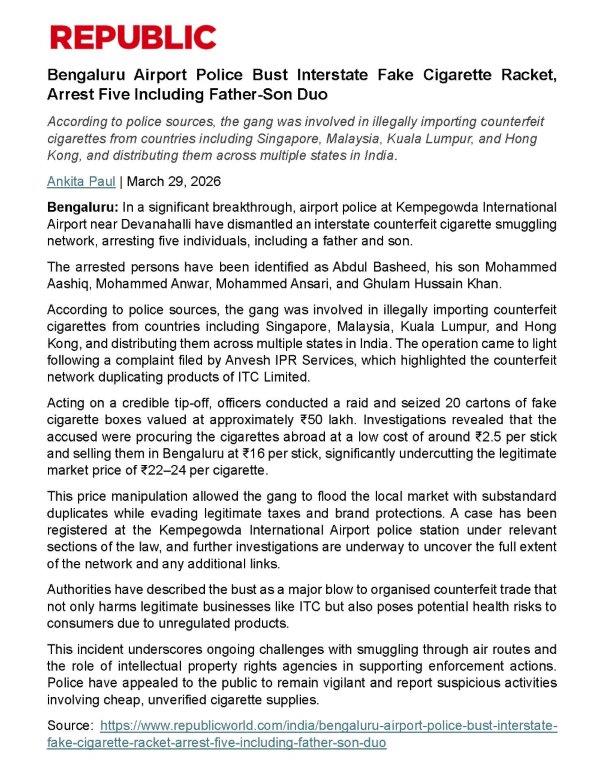
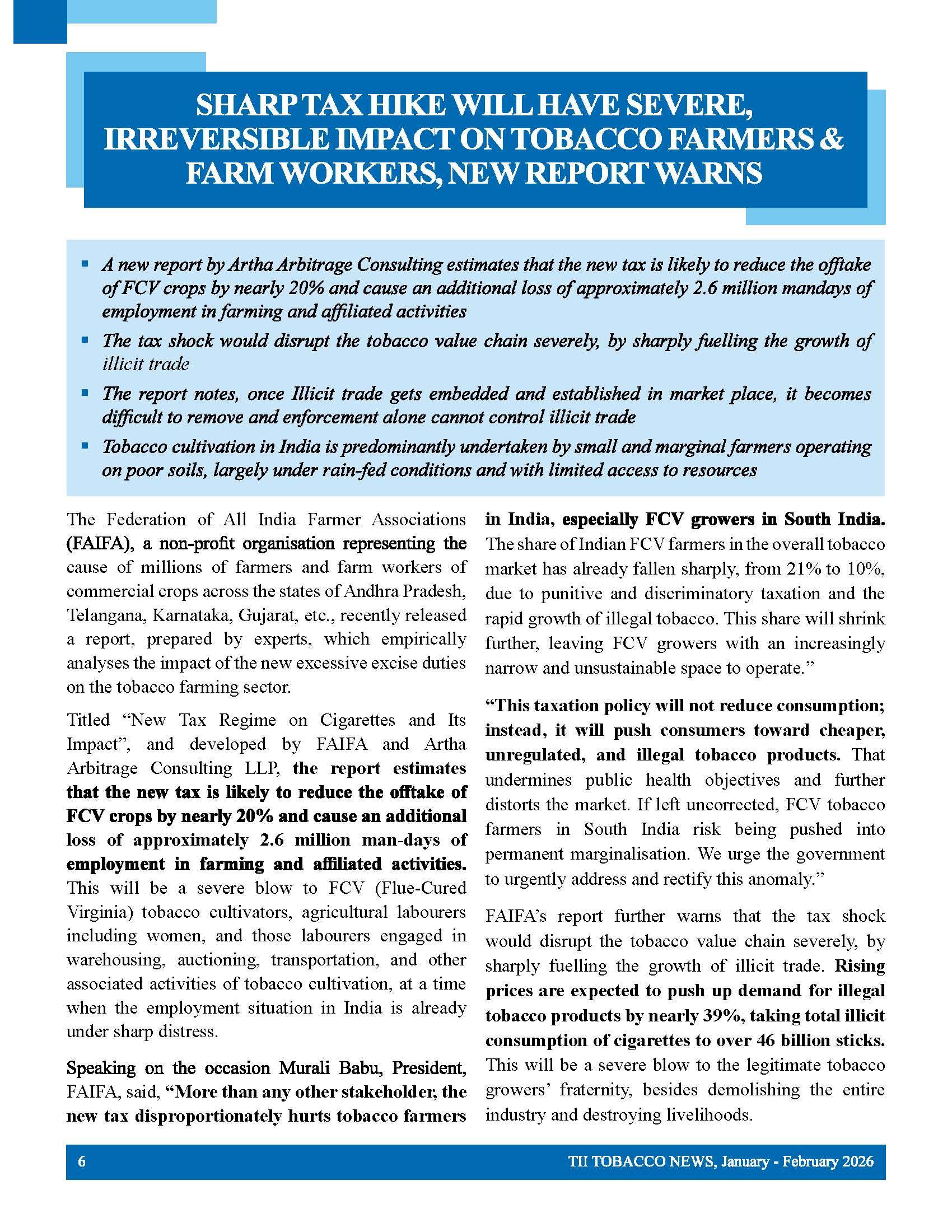
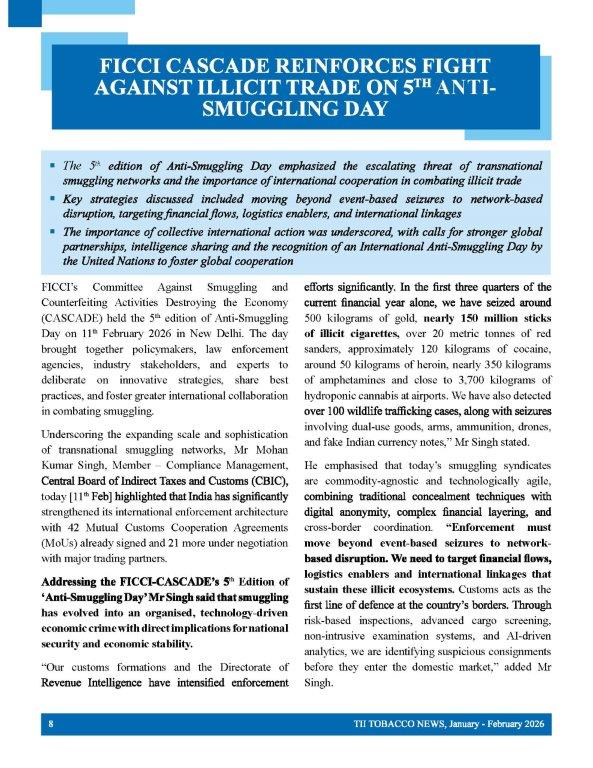
This huge increase in tax burden will result in increased tax arbitrage and provide an enormous impetus to the already large illicit cigarette market in the country.